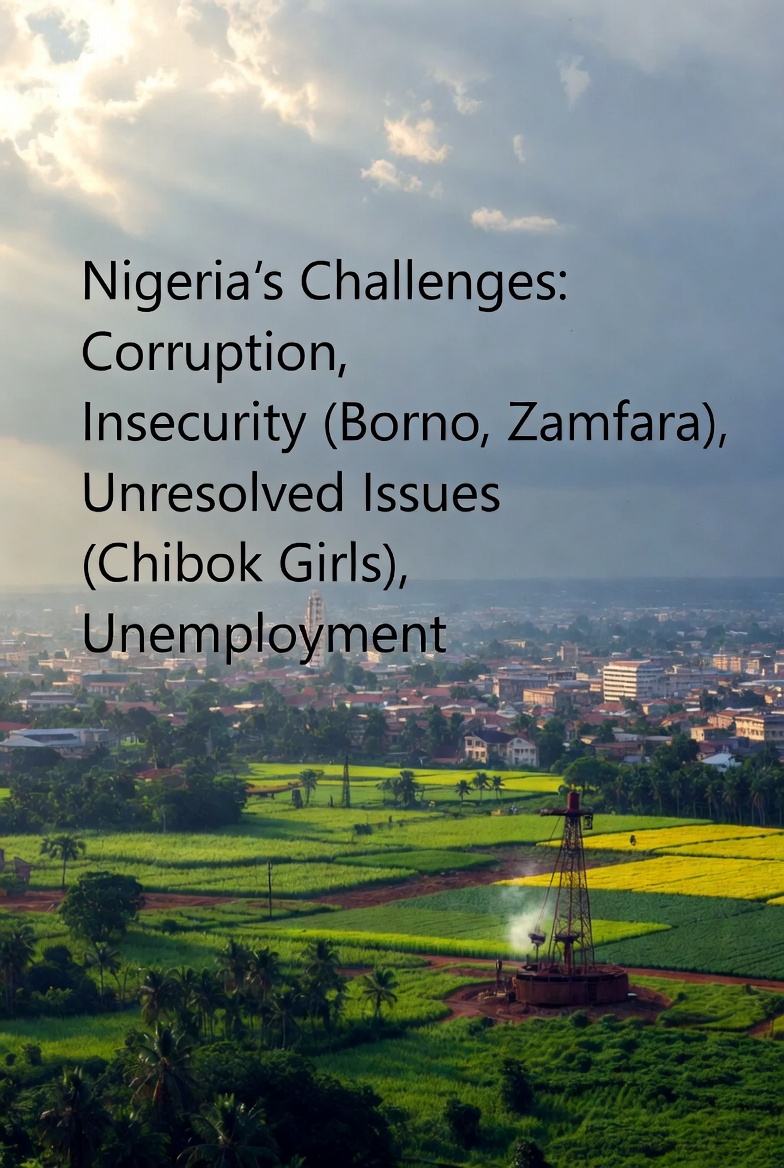
Nigeria, a country blessed with richness in its soil, its people brimming with the brilliance of life and multiculture, the land blessed with extraordinary citizens who possess burning desires to be much more. Her soil, vast and divinely blessed with extraordinary natural resources and fertility. It is no news though, that amidst all these brimming qualities the current circumstances surrounding the affairs of Nigeria as a whole is enough to thrust any concerned citizen into a state of melancholy, this may seem as an overstatement or exaggeration, given the underlining severity of the aforementioned statement. One might consider the aforementioned assertion following from the current predicaments taking place in the country, from the robust state of corruption, the ever-growing state of insecurity within the country, which is an affront to the social contract existing between the citizens of the country and the government who promised security, in return for the choice of citizens not to take laws into their hands. The entire citizens of Nigeria, are well aware of the state of insecurity in states like Borno, Zamfara, Kaduna, Ondo and more, as well as the sad story of the Chibok girls that were adopted in Borno on the night of 14th -15th of April 2014, who till date have not been accounted for, or a more recent occurrence which involved the kidnapping and eventual murder of a fish trader and tiktoker, popularly known as ‘Fish Magnet’. These occurrences and many others are all born from the high level of insecurity in the country. Speaking of security, let us further look at the state of inability of the government to create employment opportunities for its citizens, every year thousands of students graduate from the educational sector only to be hit with the harsh reality of unemployment or lack of employment opportunities. This of course has greatly affected the purchasing power of the citizens of Nigeria. One might even say, that considering all these predicaments, there is no security for Nigeria’s future. Affected and concerned Nigerians may out of lament ask questions like; why is all these happening? why are things so difficult for the lower class? But the question to be asked is not why these things happen in Nigeria, but where did we go wrong? when did the “The Fatman” step into the hearts of Africans and more specifically Nigerians? And why do the so-called corrupt people in power seem to get away with grave money laundering and embezzlement? It is therefore the preoccupation of this section to ask these questions and render highly personal opinionated answers to them, and inspire or otherwise spark inquisitive thinking in the minds of readers. This hopefully, would create a state of political and socio-political awareness in the minds of Nigerian citizens alike.
It may be said that the first detrimental mistake of Nigeria, took place during the colonial era. What if Nigeria should not have become Nigeria. What if it the amalgamation of the southern and the northern protectorates with the Lagos colony should have never taken place. The first amalgamation of Nigeria was done in 1906 when the Lagos colony was amalgamated with the southern protectorate, and was later amalgamated with the northern protectorate in 1914. Nigeria is made up of three major ethnic groups and over 250 subethnic groups, we can infer from this that these ethnic groups were in existence at the time of the amalgamation of the various territories, this was an amalgamation of people with diverse culture and practices as well as beliefs and values, which of course never ended well despite differing opinions by some section of the public. In an article published in the Punch newspaper, 15th July 2016, containing a conversation of Fola Ojo and a man whose name was Idirs. In said conversation, Ojo asked Idris a rather thought-provoking question, he asked thus “Do you think we really love one another in this country? Do you think the Hausa man truly loves the Igbo man, or the Yoruba man truly loves the Hausa man or the Igbo man loves the Hausa man?”. This question cannot be said to be farfetched given the fact that prior to the amalgamation, these ethnic groups were independent of themselves, imagine forcing people of different beliefs and culture together, it is akin to forcing opposing sides of a magnet together. The word ‘forcing’ was used because there is no indication from Nigeria’s history, that these protectorates were given the option to refuse amalgamation. It is no news that there has been a growing tension between the south east and north of Nigeria, provoking the desire for separation from Nigeria, hence the Biafra people. This is simply the backlash of the amalgamation of territories with different customs and beliefs. In light of this, this section is of the opinion that said amalgamation should not have taken place in the first place.
Furthermore, we may be faced with the possibility, that the constitution is not without flaws, following the exploitation of the lacunas(loop holes) present in the sections of the constitution. The 1999 constitution was drafted in pari materia(similar) to the 1979 Constitution which of course had its flaws. The question therefore is whether it was erroneous to have drafted a constitution based on the 1979 constitution, maybe the flaws of the referential constitution was adopted in the existing constitution. The Nigerian constitution is the body of rules that govern the actions of the Nigerian government, as well as prescribes its duties and functions in the assurance of an effective governance. As earlier stated, the constitution prescribes ‘responsibilities’ and policies, which the Nigerian government ought to perform. Speaking of ‘responsibility’ the constitution clearly uses the word responsibility in its itemization of the fundamental objectives of the government, such as; social, environmental, economic, political and educational objectives. By the provision of these objectives, the average Nigerian ought to enjoy a rich economic state of the country, as well as free primary and university education including adult literacy programs. The educational objectives provide that the Nigerian government ought to insure the eradication of illiteracy in Nigeria. In Nigeria today, of the estimated 200 million population, over 76 million adults are non-literate, this is to the exclusion of innocent children hawking on the roads and streets, you would therefore agree that the illiteracy level within the country is still on the high side, given the fact that education in Nigeria has eluded the capacity of the poor masses to afford. Ironically, these ‘responsibilities’ has been made non-justiciable by the provisions of section 6(6)C, meaning that the government cannot be held liable for their failure to provide these fundamental objectives. Is that not contradictory to the use of the word ‘responsibility’? Was that a way imputed in the constitution for the government to escape liability for their shortcomings? There is also the issue of the ‘immunity clause’ provided by the constitution, which certain executive officers enjoy, and is also enjoyed to some extent, by the legislative and judicial arm of government. This immunity as opposed to its original purpose, has created room for government officials protected by this clause, to abuse and exploit their offices without repercussions.
It is pertinent to note that this section does not encompass all the issues pertaining to areas Nigeria went wrong. It is also important to state that despite these challenges that becloud this great nation, all hope is not lost. There is always a bright future to look forward to, for where there is uncertainty, there are boundless possibilities, as such we owe it to the future generation to ensure the safety and security of those yet unborn. Never lose faith and pride in the Nigeria that is to come. Rather than remain in the shackles that constrain us from the past, let us break free from them by working together for the assurance of a bright and vibrant future. Let us ask ourselves questions that spark interest in the future. If we know where we went wrong, let us ask ourselves, HOW CAN WE FIX OUR MISTAKES?